
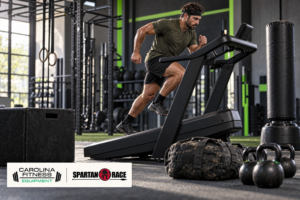
A Spartan Race is more than a run. It challenges your endurance, grip, power, coordination, and ability to keep moving when you are tired. A smart training plan combines purposeful treadmill work with functional movements that build the strength and conditioning needed for climbs, carries, jumps, crawls, and obstacle transitions.
Whether you are preparing for your first Sprint or aiming for a longer Super or Beast, the goal is the same: build a reliable engine, then teach your body to perform when your heart rate is elevated.
Start With the Right Treadmill Training
Running is the foundation of most obstacle-course races, so a treadmill is one of the most useful pieces of equipment in a Spartan-focused training space. The best choice is a durable treadmill that can handle frequent interval work and offers a meaningful incline range. Incline training is especially valuable because it helps prepare athletes for uphill terrain while challenging the glutes, hamstrings, calves, and cardiovascular system.
Look for a treadmill with a stable deck, responsive speed and incline controls, and enough durability for repeated use. A wider running surface can also help athletes feel more confident during hard interval sessions. Decline capability is a bonus for athletes who want to prepare for the eccentric demands of descending hills, but a quality incline treadmill is the priority.
Use your treadmill work in three ways:
•Base endurance runs: Build the aerobic capacity to stay moving for the length of your event. Begin with steady, conversational-effort runs and gradually increase duration over time.
•Hill intervals: Alternate hard incline efforts with easier recovery periods. For example, run or power-walk at a challenging incline for two minutes, recover for one minute, and repeat for six to eight rounds.
•Race-effort intervals: Mix moderate incline running with short bursts of faster pace. This teaches you to recover after obstacles and get back to running efficiently.
Build Explosive Power With a 3-in-1 Plyo Box
Spartan-style obstacles often require quick, powerful movement. Box jumps are a simple way to train lower-body explosiveness, coordination, and confidence under fatigue. A durable 3-in-1 plyo box gives athletes multiple height options, making it practical for beginners and experienced competitors alike.
Focus on controlled reps instead of chasing height. Step down between repetitions, reset your stance, and land softly with your knees tracking over your toes. If an athlete is not ready for box jumps, elevated step-ups are an excellent alternative that still builds single-leg strength and climbing endurance.
Try pairing short incline treadmill intervals with sets of box jumps or step-ups. That combination simulates the transition from running to an obstacle that demands power and control.
Use Kettlebells for Power, Conditioning, and Grip
Kettlebells are ideal for obstacle-course training because they combine strength, explosiveness, and cardiovascular demand in one tool. Swings develop hip power for jumping and climbing, while goblet squats build leg strength and trunk stability. Carries challenge grip strength and posture—two qualities that matter when obstacles start to add up.
A simple kettlebell circuit can include swings, goblet squats, reverse lunges, and farmer carries. Start with a load that allows clean, repeatable movement. Quality reps are more valuable than rushing through a workout with poor form.
Add Boxing and Sandbag Carries for Full-Body Conditioning
A heavy punching bag is a high-energy conditioning option that can build upper-body endurance, rotational power, and mental toughness. Work in timed rounds, such as three minutes of controlled punches followed by one minute of recovery. Keep the emphasis on solid technique, a stable stance, and consistent output rather than swinging wildly when fatigue sets in.
Sandbag carries may be one of the closest gym-based movements to the feel of an obstacle course. Carry a sandbag in a bear-hug position, over one shoulder, or in a front-rack hold. The uneven load forces the core, upper back, grip, and legs to work together while the athlete keeps moving.
For a simple progression, start with shorter carries and manageable loads, then increase distance before increasing weight. A sandbag carry after a treadmill interval is an effective way to practice moving under fatigue.
Sample Spartan Race Training Circuit
After a five- to 10-minute warm-up, complete three to four rounds of the following circuit:
1.Treadmill incline run or power-walk: 3 minutes at a challenging but sustainable pace
2.3-in-1 plyo box jumps or step-ups: 10–12 repetitions
3.Kettlebell swings: 15 repetitions
4.Heavy punching bag work: 45 seconds of controlled combinations
5.Sandbag bear-hug carry: 100 feet
6.Recovery: 60–90 seconds before the next round
Adjust the pace, weight, box height, and work intervals to match the athlete’s current experience level. Beginners can use step-ups, lighter kettlebells, shorter carries, and longer recovery. More experienced racers can increase incline, load, and total rounds while maintaining good movement quality.
Train for the Demands, Not Just the Distance
The best Spartan Race preparation includes consistent running, but it should not stop there. A training space equipped with a dependable incline treadmill, 3-in-1 plyo box, kettlebells, punching bag, and sandbags gives athletes the tools to develop the endurance and functional strength that obstacle-course racing requires.
Carolina Fitness Equipment helps facilities build practical training environments for athletes at every level. If you are planning a functional training area, upgrading cardio equipment, or adding versatile conditioning tools to your facility, our team can help you select equipment that is built to perform.